
Adam Ensign

Encountering the Manchu Bible: Language, Culture, and History

Saturday, November 21, 4:00 – 6:00 pm EST

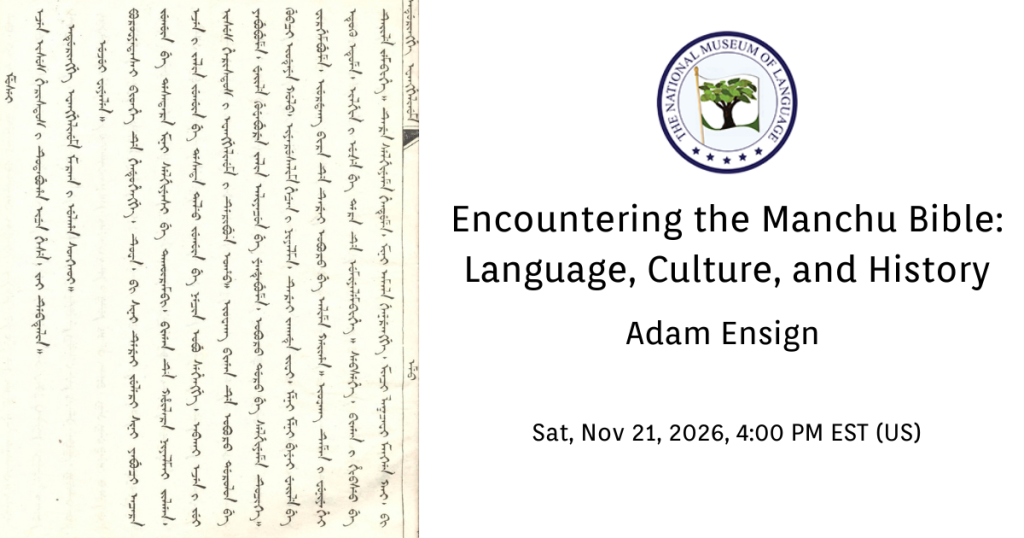
In this online talk, Adam Ensign presents the two versions of Manchu Biblical texts produced during the Qing dynasty (1644–1911). The first is a collection of Old and New Testament books translated and annotated by Louis Antoine de Poirot, S.J. (1735-1813), and the second is the New Testament translated by the Russian orthodox missionary Stepan Vaciliyevich Lipovtsov (1770–1841) and edited by the British Protestant writer George Borrow (1803–1881). Situating the sacred texts and translation projects within the linguistic, cultural, political, and religious context of the Qing dynasty (1644-1911), Adam draws from his transcription of the Manchu Biblical texts in the State Library of New South Wales in Australia and the Toyo Bunko (Oriental Library) in Japan to share intriguing examples of the enculturation of Christianity into a Manchu context.

About the Speaker
Adam Ensign

Adam Ensign earned his BA in Biblical research from Central Christian College of the Bible (2005), after which he resided in Beijing where he obtained his MA in linguistics from Peking University (2012) and taught at Beijing Language and Culture University (2013–2016) and Renmin University (2016–2025). While serving as a translator for the Palace Museum (2013–2022), he cultivated interdisciplinary expertise through research-intensive projects spanning Chinese art, culture, and history from the Neolithic age to the present Socialist period. He has explored every major administrative district in China, including Tibet and Xinjiang, and visited countless cultural and religious sites throughout Asia. He is currently a doctoral student in the Department of Religious Studies at Fu Jen Catholic University in Taipei.


Demo Title

Demo Description


My first Popup

This will close in 20 seconds

Fanni is Radnóti's wife
Located near the Tang capital city of Chang’an, site of the modern city of Xi’an in Shaanxi province, in central China.
Soldiers of that time commonly wore a white head cloth, similar to what is still worn by some peasants in China today.  The implication is that the conscripts were so young that they didn’t know how to wrap their head cloths, and needed help from elders.
Before China’s unification under the Qin dynasty in 221 B.C. there were several competing smaller kingdoms.  Han and Qin were two of these kingdoms. Han was located east of famous mountain passes that separated that area from the power base of the Qin dynasty, with its capital in Chang’an. The Qin dynasty itself only lasted about 15 years after unification due to its draconian rule, but soldiers under Qin rule retained a reputation as strong fighters.
The area of Guanxi, meaning “west of the passes”, refers to the area around the capital city of Chang’an.
This is an alternative name for a province in western China, now known as Qinghai, which literally means “blue sea”.  Kokonor Lake, located in Qinghai, is the largest saline lake in China.  
Before China’s unification under the Qin dynasty in 221 B.C. there were several competing smaller kingdoms.  Han and Qin were two of these kingdoms. Han was located east of famous mountain passes that separated that area from the power base of the Qin dynasty, with its capital in Chang’an. The Qin dynasty itself only lasted about 15 years after unification due to its draconian rule, but soldiers under Qin rule retained a reputation as strong fighters.
Oulart Hollow was the site of a famous victory of the Irish rebels over British troops, which took place on May 27, 1798. The rebels killed nearly all the British attackers in this battle. (Source: Maxwell, W. H. History of the Irish Rebellion in 1798. H. H. Bohn, London 1854, pp 92-93, at archive.org)
The phrase "United Men" is elaborated upon in the Notes section below.

Ghetto


An Italian word meaning “foundry.” It originally referred to a part of the city of Venice where the Jews of that city were forced to live; the area was called “the ghetto” because there was a foundry nearby. The term eventually came to refer to any part of a city in which a minority group is forced to live as a result of social, legal, or economic pressure. Because of the restrictions placed upon them, ghetto residents are often impoverished.

"You’re five nine, I am do-uble two"


A reference to the year 1959 and the year 2020.

"The Currency"


Meaning US dollars - this is drawing attention to the fact that Cuba is effectively dollarized.

"Sixty years with the dom-ino stuck"


This sentence is a reference to the Cold War notion that countries would turn Communist one after the other - like dominos. Cuba was the first domino, but it got stuck - no one else followed through into communism.

رحلنا


رحلنا, or "rahalna," means "we have left."

Habibi


Habibi means "my love."

Ra7eel


Ra7eel, or "raheel," means "departure."

3awda


3awda, or "awda," means "returning."

أهلاً


أهلاً, or "ahalan," means "welcome."

a5 ya baba


a5 ya baba, pronounced "akh ya baba," means "Oh my father."

golpe


Treece translates "golpe" as "beating", which is correct, however misses the secondary meaning of the word: "coup".

Carlos


The “Carlos” referred to in the poem is most likely Carlos Bolsonaro, a politician from Rio de Janeiro and the second son of Jair Bolsonaro, Brazil’s current president. His and his father’s involvement in Marielle’s murder has been questioned and investigated.