In Praise of Scribal Art

This bilingual poem extols the chosen profession of scribes.  The Sumerian text was furnished during ancient times with a line-by-line translation into Akkadian. The photo below shows the cuneiform writing of the poem.
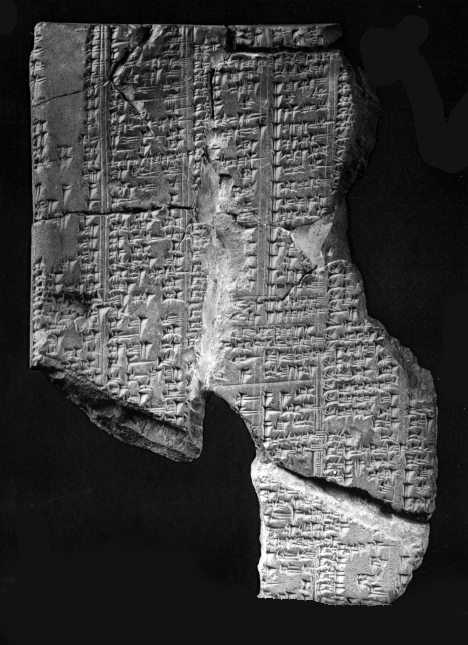
Listen to the poem in Sumerian

Sumerian

Listen to the poem in Akkadian

Akkadian

Listen to the poem in English

Sumerian
namdubsarra amagudekene aummeakesh
namdubsarra nam indabtuka lalabi nungigi
namdubsarra mezugal lusubi nundiriga
namdubsarra irpag ubiak atuku harabdahe
namdubsarra bardag ubiak sunigalla arabtuku
namdubsarra nabilen azu nanshubben
namdubsarra ea nituku kiuriammankike
igidu ummaraken kiuri nandablaen
gude nammunnabshubben sagzu didiede
namdubsarra gishshubbazilla nituku namhea
narua absarede ashaga gidede nika sadugede
dubsar aribi hea gidusu
Akkadian
tupsharrutu ummu laitat abi ummani
tupsharrutu tsaahatma lalasha ul ishshebbi
tupsharrutu la lamdat ahissa ul iaddarsha
ana tupsharrutu kipidma nemela litstsibka
ana tupsharrutu tupulma mashra lisharshika
ana tupsharrutu la egata ahka la tanamdi
tupsharrutu bit buni nitsirti ammankima
tadallipshimma nitsirtasha ukallamka
ahka tanamdishimma masiktaka iqqabbi
tupsharrutu isiq damaqi meshrie u nuhshi
nara shatari eqla shadadu nikkassa kashadu
tupshar lu arad ishassi ina tupshikku
English
The scribal art is the mother of orators, the father of masters,
The scribal art is delightful, it never satiates you,
The scribal art is not easily learned, but whoever has learned it need no longer be anxious about it.
Strive to master the scribal art and it will enrich you,
Be industrious in the scribal art and it will provide you with wealth and abundance,
Do no be careless concerning the scribal art, do not neglect it,
The scribal art is a house of richness, the secret of Amanki,
Work ceaselessly with the scribal art and it will reveal its secret to you,
If you neglect it, they will make malicious remarks about you,
The scribal art is a good lot, richness and abundance,
To write a stele, to draw a field, to settle accounts,
The scribe may be servant of the scribal art, he calls for the corvee basket.

Historical Information

In Praise of the Scribal Art

The tablet under consideration here dates to the first millennium BCE.  The text was probably used to examine students who were training to become scribes.  Its linguistic obscurities and unusual phraseology imply the document might be an academic concoction.

Near the middle of the poem, “Amanki” is a dialectial spelling of the name for the water god Enki–also known as Ea.  His appearance in the composition may have been an attempt to expand Enki’s role to include patronage of scribes.

The mention of a corvee basket in the final line may be meant to encourage a pupil to study hard toward mastering the scribal art.

Sources

In Praise of the Scribal Art translation and both transliterations based on Åke W. Sjöberg, “In Praise of the Scribal Art,” Journal of Cuneiform Studies 24.4 (1972): 126-31.  Used by permission.

Curated by Edwin Hostetter, Department of Religion, George Washington University

Demo Title

Demo Description


My first Popup

This will close in 20 seconds

Fanni is Radnóti's wife
Located near the Tang capital city of Chang’an, site of the modern city of Xi’an in Shaanxi province, in central China.
Soldiers of that time commonly wore a white head cloth, similar to what is still worn by some peasants in China today.  The implication is that the conscripts were so young that they didn’t know how to wrap their head cloths, and needed help from elders.
Before China’s unification under the Qin dynasty in 221 B.C. there were several competing smaller kingdoms.  Han and Qin were two of these kingdoms. Han was located east of famous mountain passes that separated that area from the power base of the Qin dynasty, with its capital in Chang’an. The Qin dynasty itself only lasted about 15 years after unification due to its draconian rule, but soldiers under Qin rule retained a reputation as strong fighters.
The area of Guanxi, meaning “west of the passes”, refers to the area around the capital city of Chang’an.
This is an alternative name for a province in western China, now known as Qinghai, which literally means “blue sea”.  Kokonor Lake, located in Qinghai, is the largest saline lake in China.  
Before China’s unification under the Qin dynasty in 221 B.C. there were several competing smaller kingdoms.  Han and Qin were two of these kingdoms. Han was located east of famous mountain passes that separated that area from the power base of the Qin dynasty, with its capital in Chang’an. The Qin dynasty itself only lasted about 15 years after unification due to its draconian rule, but soldiers under Qin rule retained a reputation as strong fighters.
Oulart Hollow was the site of a famous victory of the Irish rebels over British troops, which took place on May 27, 1798. The rebels killed nearly all the British attackers in this battle. (Source: Maxwell, W. H. History of the Irish Rebellion in 1798. H. H. Bohn, London 1854, pp 92-93, at archive.org)
The phrase "United Men" is elaborated upon in the Notes section below.

Ghetto


An Italian word meaning “foundry.” It originally referred to a part of the city of Venice where the Jews of that city were forced to live; the area was called “the ghetto” because there was a foundry nearby. The term eventually came to refer to any part of a city in which a minority group is forced to live as a result of social, legal, or economic pressure. Because of the restrictions placed upon them, ghetto residents are often impoverished.

"You’re five nine, I am do-uble two"


A reference to the year 1959 and the year 2020.

"The Currency"


Meaning US dollars - this is drawing attention to the fact that Cuba is effectively dollarized.

"Sixty years with the dom-ino stuck"


This sentence is a reference to the Cold War notion that countries would turn Communist one after the other - like dominos. Cuba was the first domino, but it got stuck - no one else followed through into communism.

رحلنا


رحلنا, or "rahalna," means "we have left."

Habibi


Habibi means "my love."

Ra7eel


Ra7eel, or "raheel," means "departure."

3awda


3awda, or "awda," means "returning."

أهلاً


أهلاً, or "ahalan," means "welcome."

a5 ya baba


a5 ya baba, pronounced "akh ya baba," means "Oh my father."

golpe


Treece translates "golpe" as "beating", which is correct, however misses the secondary meaning of the word: "coup".

Carlos


The “Carlos” referred to in the poem is most likely Carlos Bolsonaro, a politician from Rio de Janeiro and the second son of Jair Bolsonaro, Brazil’s current president. His and his father’s involvement in Marielle’s murder has been questioned and investigated.