
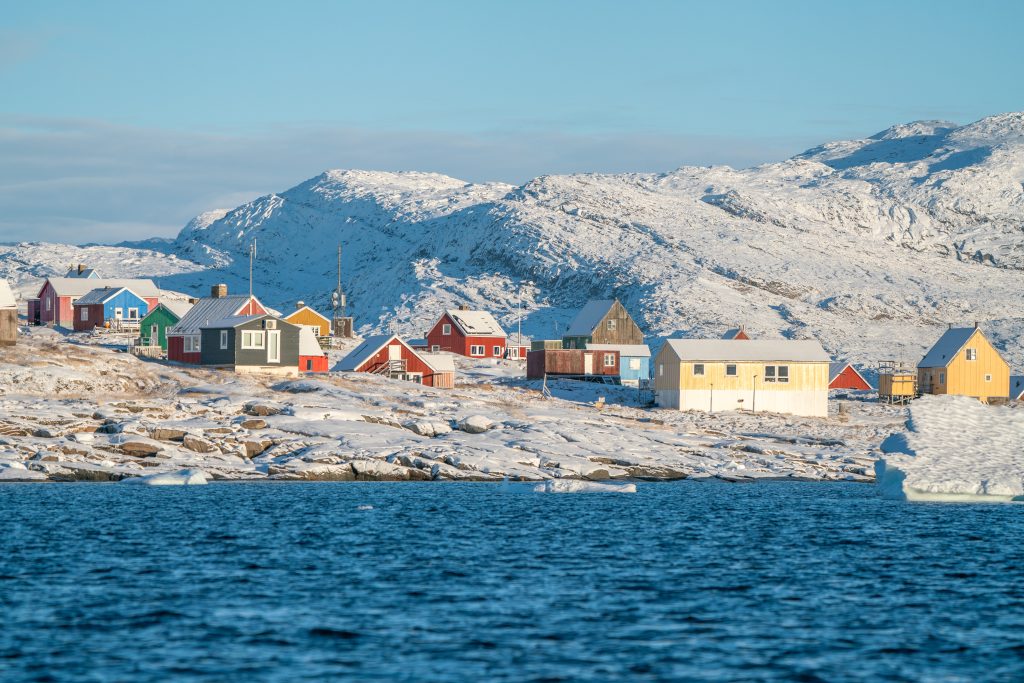
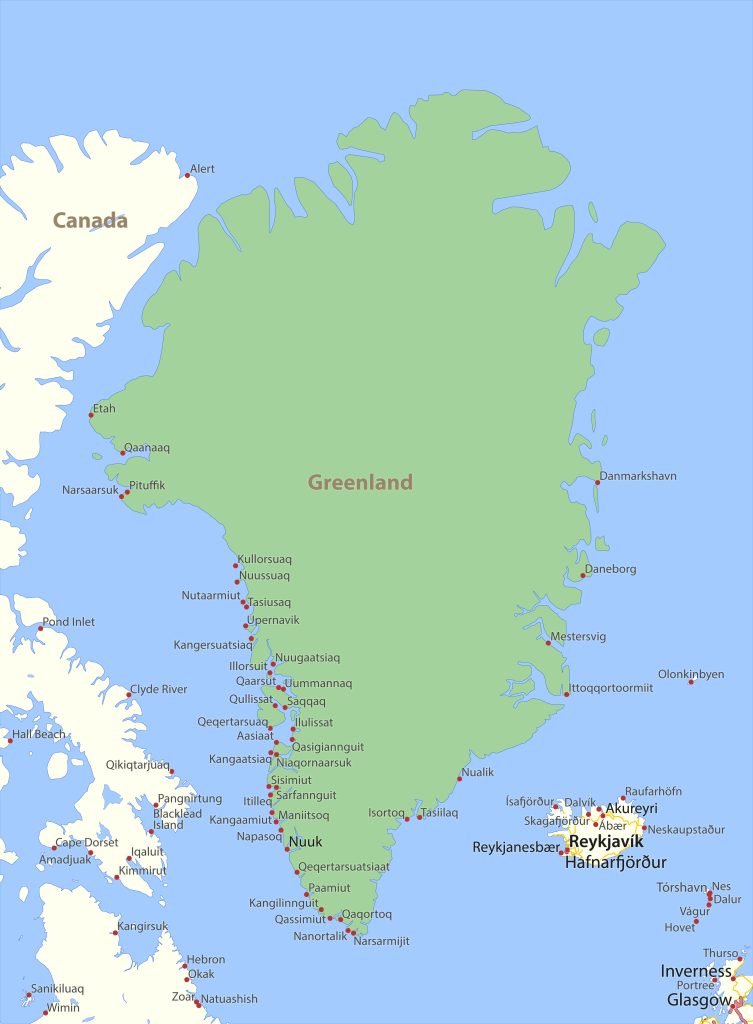
Greenlandic, known as Kalaallisut within the language, is spoken by most people in Greenland. It belongs to the Inuit branch of the Eskimo-Aleut language family, but contains loanwords from Danish, Icelandic, Norwegian, Faroese, Finnish, and English. This means that while the language has been influenced by European colonization and continued globalization, it is naturally closer to the Indigenous languages of North American Artic peoples. It is even fairly intelligible to Inuktitut in Nunavut. This language is spoken by around 50,000 people mostly in Greenland but also by a few thousand people in Denmark. Out of the approximately 57,000 people living in Greenland, most speak the language as their native tongue, while the rest of the population speaks Danish and/or English. Yet, all three languages are typically taught to children, along with other languages in school such as German and French.
Greenlandic has three main dialects: West Greenlandic (Kalaallisut) – also considered the main dialect, East Greenlandic (Tunumiisut / Tunumiit oraasiat), and North Greenlandic (Avanersuarmiutut). The West dialect is by far the most widely spoken and is the dialect used exclusively in schools. While the East dialect is spoken by around 3,000 people in the southeast of Greenland in and around Tasiilaq. The smallest of the dialects is the Northern dialect, spoken by around 800 people. It is considered the closest to other North American Indigenous/First Peoples languages.
It is believed that the language was first brought to Greenland by the Thule people in the 1200s, with any earlier languages spoken by the Saqqaq and the Dorset cultures unknown to us. The first dictionary of the language was published in 1750 by Danish missionaries, and the first grammar following just ten years later. Written also by a linguist missionary was the first orthography in 1851. An updated one was released in 1973, which brought the written version of the language much closer to the spoken version. The language’s alphabet uses Latin letters; containing eighteen letters – three of which being vowels – but it can include an extra eleven letters to account for largely Danish loanwords. This language is a polysynthetic language, adding prefixes and suffixes and other morphemes to add meaning to a singular word. This can also mean that just a singular word can be a whole sentence by itself. The nouns are affected by one of eight cases while the verbs change depending on which of the eight moods. Verbs do not change based on tense, meaning time is conveyed through helping words such as “tomorrow”, “yesterday”, or “today”. Word order follows a ‘subject – object – verb’ structure.
Representing a larger initiative to encourage Inuit culture, Greenlandic became the sole official language of Greenland in 2009. It previously shared that status with Danish as a bilingual system. Today, around 90% of the population still speaks the language, making it one of the most successful indigenous languages in terms of status and preservation.
Listen to the language here: