
The Board of Trustees of the National Museum of Language is saddened to hear of the passing of one of our most active and influential founders, Joseph E. Page, on Monday, July 9, 2018. See a newsletter article below describing Joe’s service to the Museum as one of the founding Trustees.
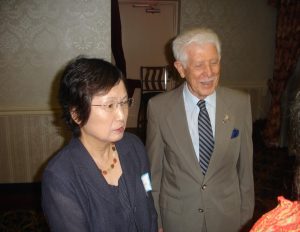
Here is the Gasch’s Funeral Home obituary:
On Monday, July 9, 2018 of College Park, MD. Beloved husband of the late Olga J. Page. Loving father of Mary Jane Tomlinson, Robert James Page, and the late Ronald Douglas Page. Grandpa of Elise Tomlinson, Dara McBee, and Jenifer Carlson. Great-grandpa of Arylle Hubbard, Leah Page Carlson, and Shane McBee. Brother of Adrianna Paris, Olga Scileppi, Norma Voels, and Albert Pagliaro. He was the oldest sibling of eleven, a highly decorated Army Officer in the Corp of Engineers. He is a veteran of two foreign wars, as well as the former mayor of College Park, MD. Friends may call at Price Funeral Home, 325 Main Street, Meyersdale, PA on Monday, July 16 from 11 AM till 12 noon. A graveside service will follow at the Union Cemetery on 7th Avenue in Meyersdale, PA at 12:30 PM. In lieu of flowers, memorial contributions may be made in his name to a charity of one’s choice.
Click on “Donate” to donate to the National Museum of Language in honor of Joseph E. Page:
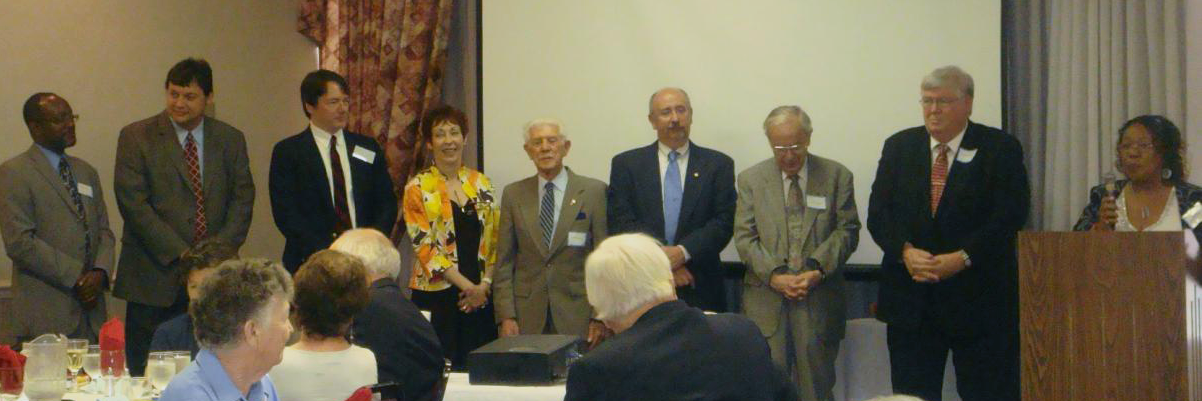

Spotlight on Joe Page – NML Newsletter 2003 5-1 3
Spotlight on Joseph E. Page
[From the National Museum of Language Newsletter, Volume 5, Issue 1, Winter 2003.]A member of the NML Board of Directors, Joseph E. Page brings the experiences from a lifetime of service to his country and his community to enrich his contributions on the Board. After a recent Board meeting, one of our newer board members exclaimed, “How lucky you are to have Joe Page on the Board!” With each passing month we have new cause to echo this sentiment, the following tour d’horizon of his life and career will explain to some extent why he was invited to serve on the Board. Our personal observations will help you understand why he is in such great demand.
A native of New York City, he was attending Brooklyn College when he volunteered for the Army in World War II. Starting as an enlisted man, he served in the Southwest Pacific: (Australia, New Guinea, the Philippine Islands) and was honorably discharged in 1945 as Second Lieutenant, a direct commission he received in the Philippines.
After two years as a civilian working for the Bank of America in San Francisco, Page returned to active duty in 1948 in the U.S. Army Corps of Engineers.
In his subsequent military career, he alternated assignments overseas and in the United States. An enumeration of his overseas posts qualifies him as well-traveled: occupation duty in Japan, the conflict in Korea, peacetime service in France/Western Europe, Japan again, and the Republic of Mali.
Old Army hands can identify with his tours at Ft. Belvoir, VA; Ft. George G. Meade, MD; Schenectady, New York, Army Depot, Ft. Lee, VA (two tours).
Education is a theme throughout his life. He was initially assigned as faculty member of Officer Candidate School at Fort Belvoir and later as Operations Officer at the engineer school there. While stationed at Fort Meade, he received his Bachelor’s degree in Military Science (with honors) from the University of Maryland. Not satisfied with this, and clearly addicted to education, on his second tour in Japan he obtained a B.A. in General Studies (with honors) at the University of Maryland in Tokyo. Later, he pursued graduate work at Ft. Lee.
Upon his retirement as Lt. Colonel in 1967, Page moved to College Park and began civilian life as an official at the Baltimore Department of Housing and Community Development. Since 1985 he has been deeply involved in many aspects of community service through membership in numerous civic and veterans’ organizations. Elected to the City Council of College Park, he subsequently served two terms as Mayor. His retirement from that post took place in 1997, the year of the founding of the National Museum of Language (NML).
Because of his well-known love of language, his service abroad, and his distinguished career as a public servant, Page was encouraged to become a candidate for the Museum’s first Board of Directors. Cherished for his tact and diplomacy, famed for the multitude of contacts who respond so willingly when he seeks their help, he stands out for his wisdom, good advice and hard work. His experiences in learning and using French and Japanese, as well as coping with the multilingual world of Mali often illumine his work with NML. In the world of language, he stands out not as a theorist or a teacher, but as a practitioner. He embodies the ideal that linguists so often praise: the individual who promotes international understanding and good will through language. He has lived the life.
- Amelia C. Murdoch (founder and President Emerita of the National Museum of Language