
A statement announcing the Regional Humanities Network has been included in the Maryland Humanities Annual Report:
The Regional Humanities Network (RHN) serves as a space where organizations from different sectors, such as community organizations, universities, colleges, libraries, museums, and historical societies, can come together to share resources, discuss challenges they are facing in their respective areas, and find solutions. Robert Forloney, Program Officer Partnerships, who spearheads the Regional Humanities Network (RHN), will conduct listening sessions to learn from our partners about patterns and explore opportunities. Our findings will inform our efforts to adapt, build trust, and engage intentionally. Recent census data indicate that about 15 percent of Maryland’s population is made up of immigrants, many of whom speak languages other than English. Given the role of Maryland Humanities in the State of Maryland, we understand that we cannot operate in isolation from the human right of Language Access. Maryland Humanities has already begun assessing its language access needs. For instance, we met with six community leaders to understand the different services they offer to multilingual audiences. We are excited to develop a language plan that will allow Maryland Humanities to identify multilingual communities and determine what materials should be translated or provide interpreters at our events.
Maryland State Liaison Dr. Richard Dabrowski, who oversees Russian and
Ukrainian instruction for government employees, spent two weeks in Poland in
May attending a special course in Ukrainian at the University of Warsaw. His
report on his trip, lightly edited was as follows:
The timing of my current trip to Poland centers on a summer Ukrainian language and
culture program developed by the University of Alberta, which has the best Ukrainian
program in North America, by reputation. The course will be presented at the University
of Warsaw, since travel to Ukraine, where they would usually go is problematic due to
the conflict with Russia. The entire summer program would be six weeks long; I’m only
attending the first two weeks, which is enough to get a taste of their presentation of the
subject. I’m enrolled as a University of Alberta student, which will be the first time I’ll be
in a classroom in many years; it will be interesting to see the program as a participant.
Here I am at the gates to the historic core buildings of the university:

Visit to Mundolingua – the Museum of Languages in Paris
by Richard Dabrowski, NML liaison for Maryland
In the shadow of the Church of Saint-Sulpice in the Latin Quarter of the 6th arrondissement you can find the privately-run museum of languages in Paris – Mundolingua. I was able to visit the museum in September 2021 soon after its reopening following pandemic-related closure and I had the place to myself as the only patron at the time of my visit.

The museum is the personal vision of Mark Oremland, a New Zealander who studied linguistics in France and went on to start a travel agency between the two countries. He collected all kinds of objects related to language and is particularly proud of an early version of the German “Enigma” coding machine and a replica of the Rosetta Stone.
Pre-pandemic the majority of visitors were school groups who were attracted to the many computer stations located on the two levels of the museum amongst the collected objects. Each station presents information on a specific area of interest; for example, this screen presents “Non-Human Language.”
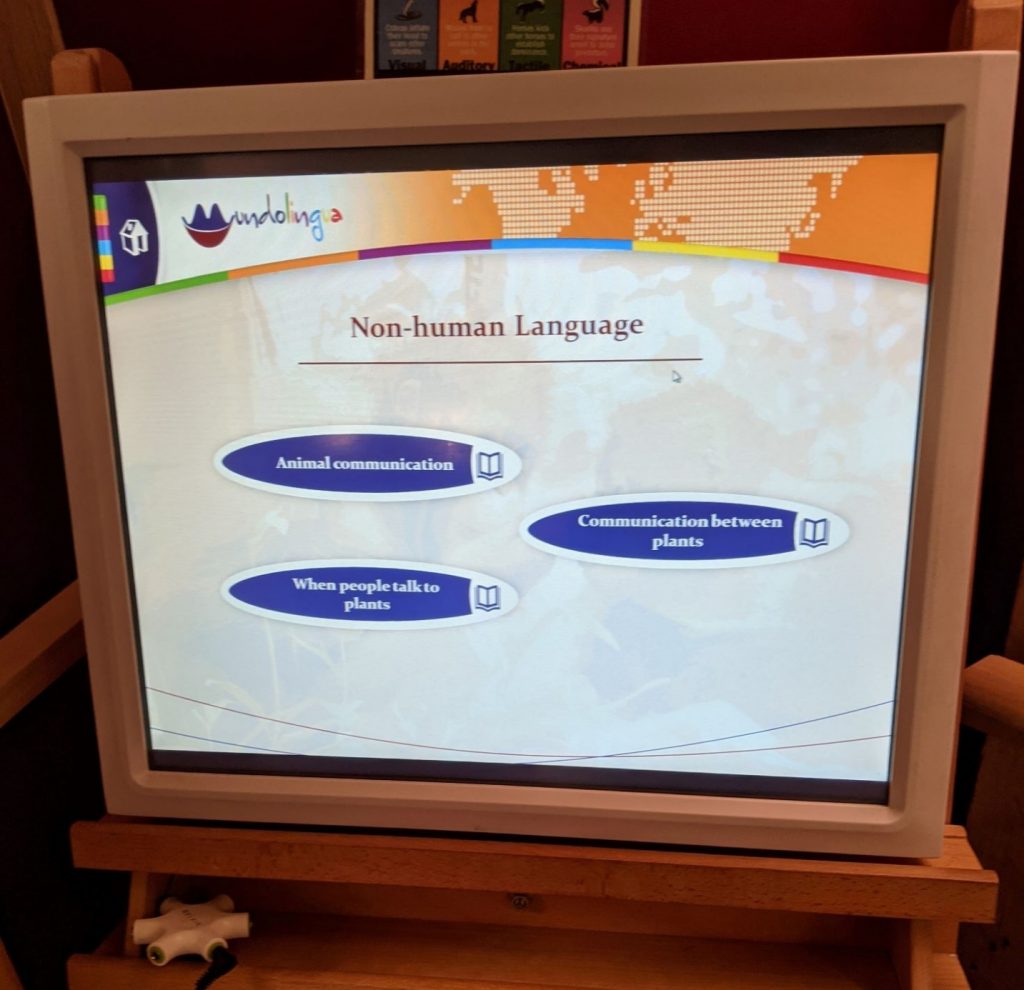
Essentially each station has PowerPoint presentations that have been translated into the six languages of the United Nations: English, French, Spanish, Russian, Chinese and Arabic. The small device you can see in the bottom left of the photo is a receptacle where you can plug in headphones to hear embedded audio and videos. The material within each option is presented in increasing levels of difficulty so that the content can appeal to various age levels. Where possible, game-like activities are added to the station.

This language-identification quiz has short audio clips and the viewer has to guess the source by inserting the numbered peg into the lettered hole in the block on the left and then comparing the resulting pattern of cords with the diagram on the block on the right. There are four variations to the quiz, which is quite tough – many of the languages to be identified are quite obscure.
I spoke with the volunteer manning the museum entrance desk [full admission for an adult is 8 Euros] and he related that the museum is barely hanging on financially due to the pandemic closure as they do not receive any government support. You can tell that the museum is a labor of love that could stand to be updated and is crammed into too small a space; that said, it has some charming displays and is well worth an hour of your time if in the vicinity.
For more information: https://www.mundolingua.org/en/