
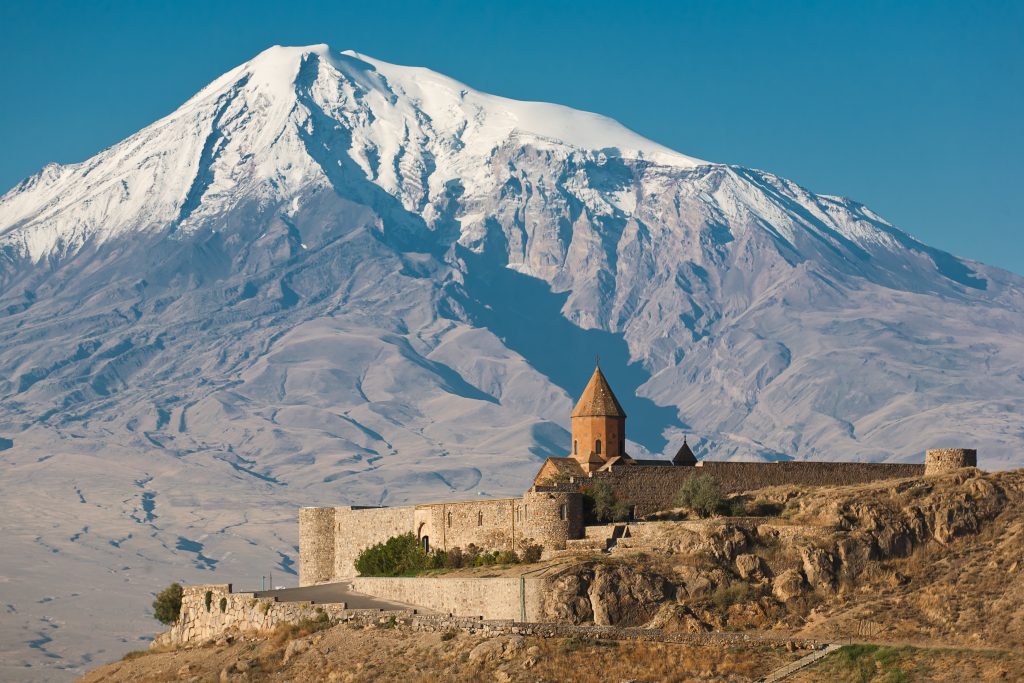
Sometimes when we do these Languages of the Month, we can trace the language through a long classification. But with Armenian and its two dialects of Eastern and Western Armenian, all that can be said is that it belongs to its own branch within the Indo-European language family.
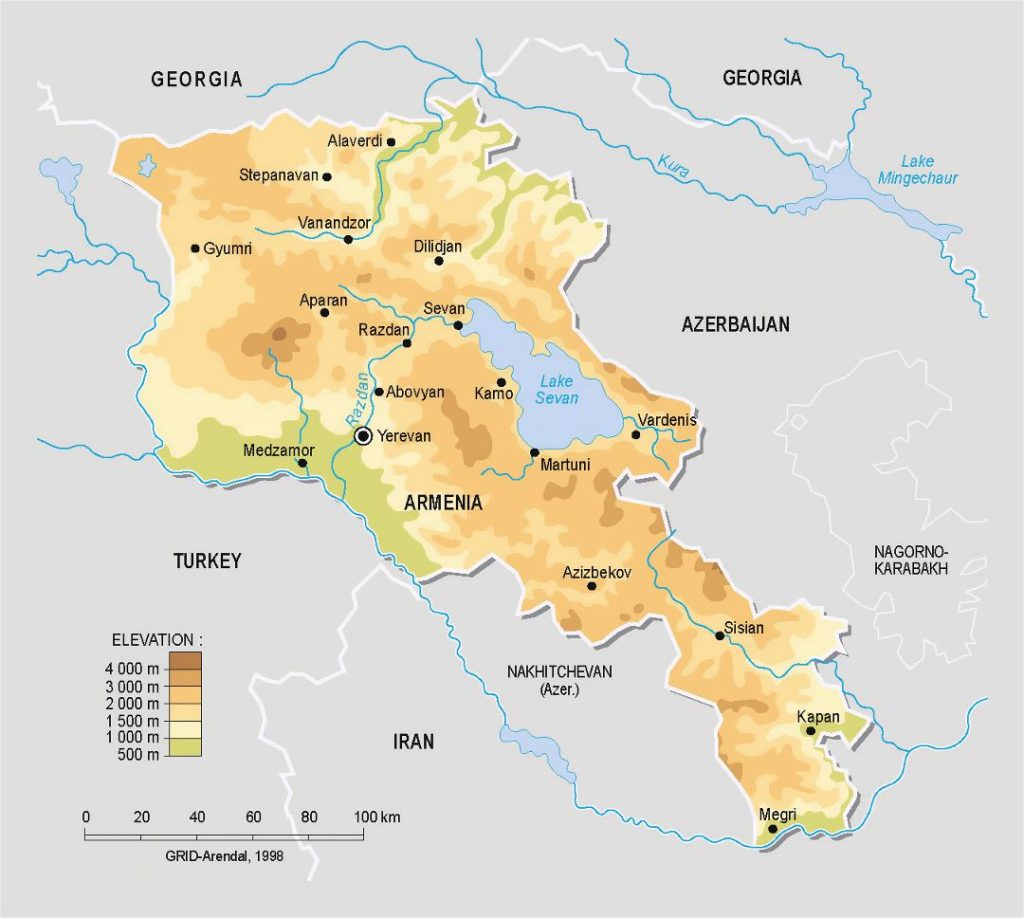
Spoken by the Armenian population which is located in Armenia and Nagorno-Karabakh, which are known as parts of Turkey, Azerbaijan, and the South Caucasus. However, the language is also spoken by small Armenian populations in Russia, Lebanon, the USA, Georgia, Iran, France, Syria, Turkey, Iraq, Uzbekistan, and Ukraine.
The total number of speakers, including both dialects which are mutually intelligible, is around 3.8 million. However, a large majority of people in Armenia speak the Eastern dialect while many Western dialect speakers reside in other countries, such as Lebanon, the US, and Georgia. The Eastern dialect is regarded as the official and common dialect in the country and has a large speaker population in Russia, Azerbaijan, and Iran. This dialect is also spoken as an official minority language in Cyprus, Hungary, Iraq, Poland, Romania, and Ukraine.
Until the 1990s, schools in Armenia were taught in both Armenian and Russian. With the fall of the USSR, Russian language schools died out and education in Armenia was exclusively Armenian. That is until 2010, when the Russian language education was reintroduced.
The alphabet was created in the 4th century and used a cuneiform-type writing system. King Vramshapuh found this to not support the religious written practices of the church by the end of the 4th century, so asked one of his officials to create a new, and better-suited, writing system. That scholar traveled to Alexandria to study written language and came up with the conclusion that using Greek was the best model for their new alphabet due to the similarity in sounds. This alphabet went on to be well-received among the speakers and would even serve as the writing system for other languages throughout history such as: Turkish, Azeri, Kipchak, and Kurdish.
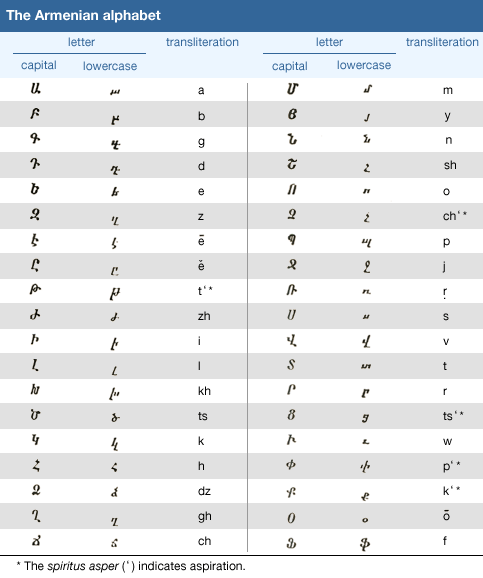
However not much is known about the language earlier than the 5th century A.D, even though there are biblical mentions of the people dating back to the 6th century BCE. The written Armenian from this time, also known as “Classical Armenian,” contains loan words from Parthian, Greek, Syriac, and Latin as well as other languages such as Urartian. In the 11th century, we see what is known as “Middle Armenian” which lasted until the 15th century and contains loan words from Arabic, Turkish, Persian, and Latin.
Eastern and Western dialects have few differences in how they pronounce the letters of the alphabet. Although names may be spelled the same, they are consistently pronounced differently between the two. Each letter also has a numerical value and the grammar includes a case system with seven different cases. as do other languages that use the Cyrillic script. Many of the forms for these cases would look the same, though, thus simplifying their usage and spelling.. While the stem determines how the verbs are conjugated, the nouns do not change because they are not distinguished by gender.
The Armenians were a large people group until the Turkic genocide in the 20th century. Since then, they have scattered to different countries seeking a peaceful life away from the ethnic violence in the Nagorno-Karabakh region. In 1915, the Ottoman Empire deported the Armenian people from eastern Anatolia to Syria and Mesopotamia. Somewhere between 600,000 to 1,500,000 died during this time. The U.S. Congress recognized this as a genocide in 2019.
In 2020 a war began in the Nagorno-Karabakh territory between Azerbaijan and Armenia. After the war, Azerbaijan continued to violate human rights of the Armenian people for three years. In 2023, Azerbaijan completed an ethnic cleansing effort of the Armenian people in the Nagorno-Karabakh region, forcing 100,000 people from their homes through violence. While tensions continue to run high, the area is no longer considered an active war zone.
I would like to take this opportunity to thank our audience, especially Jane K. for the suggestions of languages they would like to see explored in our museum.
Listen to the language here:
For more information:
“Armenian (Հայերէն).” Armenian Language and Alphabet, 14 Apr. 2024, www.omniglot.com/writing/armenian.htm.
Pisowicz, Andrzej. “Armenian Language.” Encyclopædia Britannica, Encyclopædia Britannica, inc., 30 Jan. 2025, www.britannica.com/topic/Armenian-language.
Wilder, Emily. “Atrocities and Ethnic Cleansing in Nagorno-Karabakh.” University Network for Human Rights, University Network for Human Rights, 23 Jan. 2025, www.humanrightsnetwork.org/projects/nagorno-karabakh.
https://www.cfr.org/global-conflict-tracker/conflict/nagorno-karabakh-conflict