Language of the Month January 2026 – Greenlandic

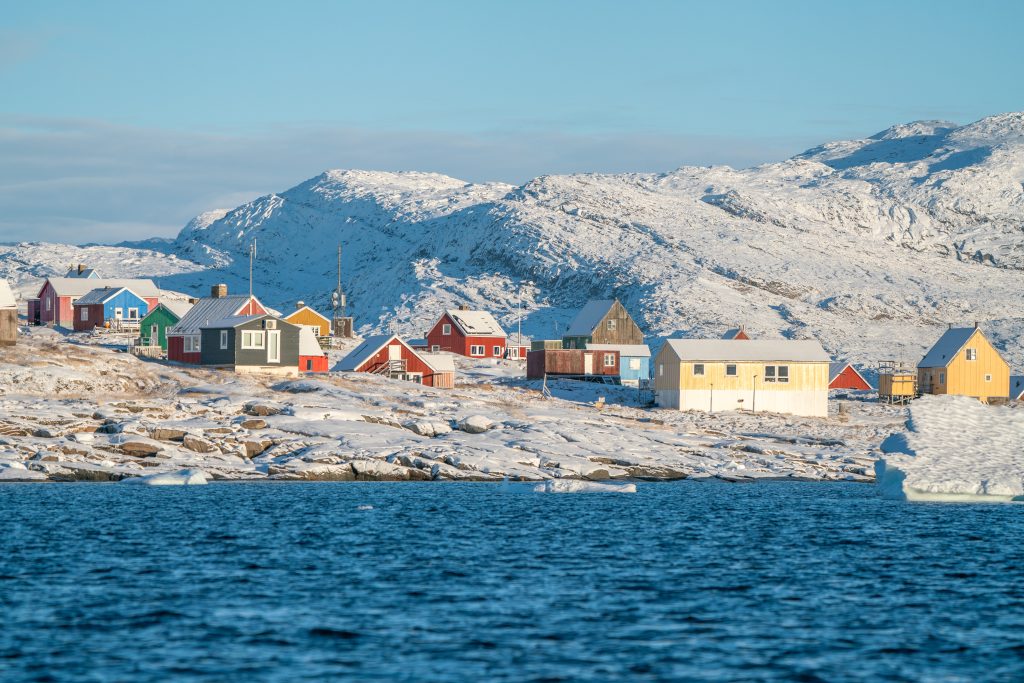
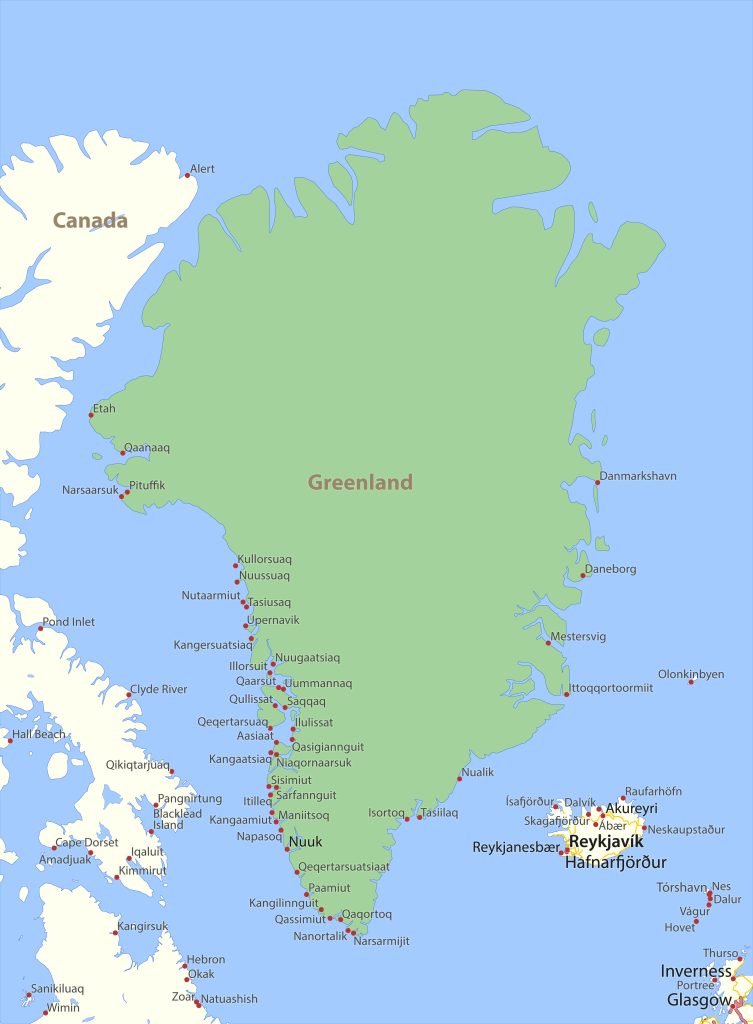
Greenlandic, known as Kalaallisut within the language, is spoken by most people in Greenland. It belongs to the Inuit branch of the Eskimo-Aleut language family, but contains loanwords from Danish, Icelandic, Norwegian, Faroese, Finnish, and English. This means that while the language has been influenced by European colonization and continued globalization, it is naturally closer to the Indigenous languages of North American Artic peoples. It is even fairly intelligible to Inuktitut in Nunavut. This language is spoken by around 50,000 people mostly in Greenland but also by a few thousand people in Denmark. Out of the approximately 57,000 people living in Greenland, most speak the language as their native tongue, while the rest of the population speaks Danish and/or English. Yet, all three languages are typically taught to children, along with other languages in school such as German and French.

Greenlandic has three main dialects: West Greenlandic (Kalaallisut) – also considered the main dialect, East Greenlandic (Tunumiisut / Tunumiit oraasiat), and North Greenlandic (Avanersuarmiutut). The West dialect is by far the most widely spoken and is the dialect used exclusively in schools. While the East dialect is spoken by around 3,000 people in the southeast of Greenland in and around Tasiilaq. The smallest of the dialects is the Northern dialect, spoken by around 800 people. It is considered the closest to other North American Indigenous/First Peoples languages.
It is believed that the language was first brought to Greenland by the Thule people in the 1200s, with any earlier languages spoken by the Saqqaq and the Dorset cultures unknown to us. The first dictionary of the language was published in 1750 by Danish missionaries, and the first grammar following just ten years later. Written also by a linguist missionary was the first orthography in 1851. An updated one was released in 1973, which brought the written version of the language much closer to the spoken version. The language’s alphabet uses Latin letters; containing eighteen letters – three of which being vowels – but it can include an extra eleven letters to account for largely Danish loanwords. This language is a polysynthetic language, adding prefixes and suffixes and other morphemes to add meaning to a singular word. This can also mean that just a singular word can be a whole sentence by itself. The nouns are affected by one of eight cases while the verbs change depending on which of the eight moods. Verbs do not change based on tense, meaning time is conveyed through helping words such as “tomorrow”, “yesterday”, or “today”. Word order follows a ‘subject – object – verb’ structure.

Representing a larger initiative to encourage Inuit culture, Greenlandic became the sole official language of Greenland in 2009. It previously shared that status with Danish as a bilingual system. Today, around 90% of the population still speaks the language, making it one of the most successful indigenous languages in terms of status and preservation.

Listen to the language here:

Read more about it here:

Demo Title

Demo Description


My first Popup

This will close in 20 seconds

Fanni is Radnóti's wife
Located near the Tang capital city of Chang’an, site of the modern city of Xi’an in Shaanxi province, in central China.
Soldiers of that time commonly wore a white head cloth, similar to what is still worn by some peasants in China today.  The implication is that the conscripts were so young that they didn’t know how to wrap their head cloths, and needed help from elders.
Before China’s unification under the Qin dynasty in 221 B.C. there were several competing smaller kingdoms.  Han and Qin were two of these kingdoms. Han was located east of famous mountain passes that separated that area from the power base of the Qin dynasty, with its capital in Chang’an. The Qin dynasty itself only lasted about 15 years after unification due to its draconian rule, but soldiers under Qin rule retained a reputation as strong fighters.
The area of Guanxi, meaning “west of the passes”, refers to the area around the capital city of Chang’an.
This is an alternative name for a province in western China, now known as Qinghai, which literally means “blue sea”.  Kokonor Lake, located in Qinghai, is the largest saline lake in China.  
Before China’s unification under the Qin dynasty in 221 B.C. there were several competing smaller kingdoms.  Han and Qin were two of these kingdoms. Han was located east of famous mountain passes that separated that area from the power base of the Qin dynasty, with its capital in Chang’an. The Qin dynasty itself only lasted about 15 years after unification due to its draconian rule, but soldiers under Qin rule retained a reputation as strong fighters.
Oulart Hollow was the site of a famous victory of the Irish rebels over British troops, which took place on May 27, 1798. The rebels killed nearly all the British attackers in this battle. (Source: Maxwell, W. H. History of the Irish Rebellion in 1798. H. H. Bohn, London 1854, pp 92-93, at archive.org)
The phrase "United Men" is elaborated upon in the Notes section below.

Ghetto


An Italian word meaning “foundry.” It originally referred to a part of the city of Venice where the Jews of that city were forced to live; the area was called “the ghetto” because there was a foundry nearby. The term eventually came to refer to any part of a city in which a minority group is forced to live as a result of social, legal, or economic pressure. Because of the restrictions placed upon them, ghetto residents are often impoverished.

"You’re five nine, I am do-uble two"


A reference to the year 1959 and the year 2020.

"The Currency"


Meaning US dollars - this is drawing attention to the fact that Cuba is effectively dollarized.

"Sixty years with the dom-ino stuck"


This sentence is a reference to the Cold War notion that countries would turn Communist one after the other - like dominos. Cuba was the first domino, but it got stuck - no one else followed through into communism.

رحلنا


رحلنا, or "rahalna," means "we have left."

Habibi


Habibi means "my love."

Ra7eel


Ra7eel, or "raheel," means "departure."

3awda


3awda, or "awda," means "returning."

أهلاً


أهلاً, or "ahalan," means "welcome."

a5 ya baba


a5 ya baba, pronounced "akh ya baba," means "Oh my father."

golpe


Treece translates "golpe" as "beating", which is correct, however misses the secondary meaning of the word: "coup".

Carlos


The “Carlos” referred to in the poem is most likely Carlos Bolsonaro, a politician from Rio de Janeiro and the second son of Jair Bolsonaro, Brazil’s current president. His and his father’s involvement in Marielle’s murder has been questioned and investigated.