Visit to Mundolingua – the Museum of Languages in Paris
by Richard Dabrowski, NML liaison for Maryland


In the shadow of the Church of Saint-Sulpice in the Latin Quarter of the 6th arrondissement stands the privately-run museum of languages in Paris – Mundolingua. 

In the shadow of the Church of Saint-Sulpice in the Latin Quarter of the 6th arrondissement you can find the privately-run museum of languages in Paris – Mundolingua.  I was able to visit the museum in September 2021 soon after its reopening following pandemic-related closure and I had the place to myself as the only patron at the time of my visit.

The museum is the personal vision of Mark Oremland, a New Zealander who studied linguistics in France and went on to start a travel agency between the two countries.  He collected all kinds of objects related to language and is particularly proud of an early version of the German ‘Enigma’ coding machine and a replica of the Rosetta Stone. 

Pre-pandemic the majority of visitors were school groups who were attracted to the many computer stations located on the two levels of the museum amongst the collected objects.  Each station presents information on a specific area of interest; for example, this screen presents “Non-Human Language.”
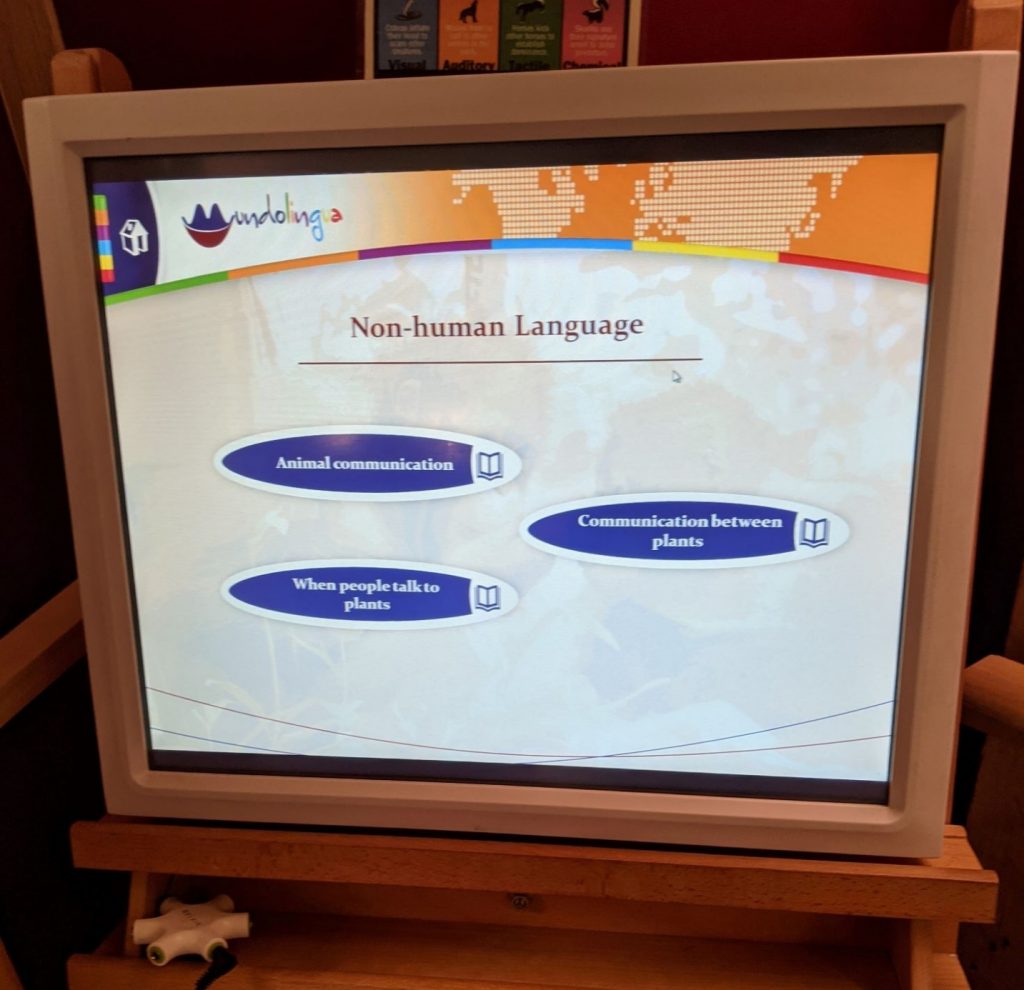
Essentially each station has PowerPoint presentations that have been translated into the six languages of the United Nations:  English, French, Spanish, Russian, Chinese and Arabic.  The small device you can see in the bottom left of the photo is a receptacle where you can plug in headphones to hear embedded audio and videos.  The material within each option is presented in increasing levels of difficulty so that the content can appeal to various age levels.  Where possible, game-like activities are added to the station.

This language-identification quiz has short audio clips and the viewer has to guess the source by inserting the numbered peg into the lettered hole in the block on the left and then comparing the resulting pattern of cords with the diagram on the block on the right.  There are four variations to the quiz, which is quite tough – many of the languages to be identified are quite obscure. 

I spoke with the volunteer manning the museum entrance desk [full admission for an adult is 8 Euros] and he related that the museum is barely hanging on financially due to the pandemic closure as they do not receive any government support.  You can tell that the museum is a labor of love that could stand to be updated and is crammed into too small a space; that said, it has some charming displays and is well worth an hour of your time if in the vicinity.

For more information:  https://www.mundolingua.org/en/

Demo Title

Demo Description


My first Popup

This will close in 20 seconds

Fanni is Radnóti's wife
Located near the Tang capital city of Chang’an, site of the modern city of Xi’an in Shaanxi province, in central China.
Soldiers of that time commonly wore a white head cloth, similar to what is still worn by some peasants in China today.  The implication is that the conscripts were so young that they didn’t know how to wrap their head cloths, and needed help from elders.
Before China’s unification under the Qin dynasty in 221 B.C. there were several competing smaller kingdoms.  Han and Qin were two of these kingdoms. Han was located east of famous mountain passes that separated that area from the power base of the Qin dynasty, with its capital in Chang’an. The Qin dynasty itself only lasted about 15 years after unification due to its draconian rule, but soldiers under Qin rule retained a reputation as strong fighters.
The area of Guanxi, meaning “west of the passes”, refers to the area around the capital city of Chang’an.
This is an alternative name for a province in western China, now known as Qinghai, which literally means “blue sea”.  Kokonor Lake, located in Qinghai, is the largest saline lake in China.  
Before China’s unification under the Qin dynasty in 221 B.C. there were several competing smaller kingdoms.  Han and Qin were two of these kingdoms. Han was located east of famous mountain passes that separated that area from the power base of the Qin dynasty, with its capital in Chang’an. The Qin dynasty itself only lasted about 15 years after unification due to its draconian rule, but soldiers under Qin rule retained a reputation as strong fighters.
Oulart Hollow was the site of a famous victory of the Irish rebels over British troops, which took place on May 27, 1798. The rebels killed nearly all the British attackers in this battle. (Source: Maxwell, W. H. History of the Irish Rebellion in 1798. H. H. Bohn, London 1854, pp 92-93, at archive.org)
The phrase "United Men" is elaborated upon in the Notes section below.

Ghetto


An Italian word meaning “foundry.” It originally referred to a part of the city of Venice where the Jews of that city were forced to live; the area was called “the ghetto” because there was a foundry nearby. The term eventually came to refer to any part of a city in which a minority group is forced to live as a result of social, legal, or economic pressure. Because of the restrictions placed upon them, ghetto residents are often impoverished.

"You’re five nine, I am do-uble two"


A reference to the year 1959 and the year 2020.

"The Currency"


Meaning US dollars - this is drawing attention to the fact that Cuba is effectively dollarized.

"Sixty years with the dom-ino stuck"


This sentence is a reference to the Cold War notion that countries would turn Communist one after the other - like dominos. Cuba was the first domino, but it got stuck - no one else followed through into communism.

رحلنا


رحلنا, or "rahalna," means "we have left."

Habibi


Habibi means "my love."

Ra7eel


Ra7eel, or "raheel," means "departure."

3awda


3awda, or "awda," means "returning."

أهلاً


أهلاً, or "ahalan," means "welcome."

a5 ya baba


a5 ya baba, pronounced "akh ya baba," means "Oh my father."

golpe


Treece translates "golpe" as "beating", which is correct, however misses the secondary meaning of the word: "coup".

Carlos


The “Carlos” referred to in the poem is most likely Carlos Bolsonaro, a politician from Rio de Janeiro and the second son of Jair Bolsonaro, Brazil’s current president. His and his father’s involvement in Marielle’s murder has been questioned and investigated.