
By now, most of us are really in the swing of things! First quarters are ending, parents have been contacted, and real language has been produced! Being back in the habit, now is the perfect time to start thinking about just what we want our students to be able to do.
For many of our day to day lessons, the culmination is the formative assessment. Whether it be an exit ticket, a skit, or a paragraph, these small, usually graded, activities, allow us to see where our students are.
However, what many of us forget is what exactly the term “formative” really means. All too often, in the mind of students, and even teachers, a formative assessment feels like the culmination of a day’s work. It’s a grade that shows how well the student understands the material. However, what we need to remember is that a formative assessment only demonstrates knowledge of a particular subject at a certain time; it is not a final product, and does not usually demonstrate culminating mastery.
But if that’s the case, how can you make a formative assessment a more meaningful, ongoing activity? There’s many ways to do this! If you are a teacher, you more than likely know about the Danielson Framework. Remember, 3D on the framework reminds us that an assignment is not the end of a lesson, but a signal where to go next. This can show itself in many ways. Most of us know that if a formative did not go particularly well, we may need to slow down the next lesson or dedicate some time to reteaching material. However, have you considered having students redo the assignment? After a reteach, hand back either a clean copy or the original formative, and have students revise or rewrite. If you were concerned about a particular topic or grammar point on the original assignment, and they are now able to produce it, then great! You did what you set out to do, and the new formative is still valid, as it shows where students are at at the end of the new lesson, which is further than the previous day!
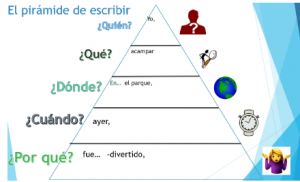 I have found this pyramid particularly useful with my level 2 students when redoing formative assignments. Notice how it gets students using their interrogatives to think about what information is being conveyed when they write or speak a sentence. Novice learners on the ACTFL scale are expected to produce simple, memorized sentences, but by the Intermediate level, they are expected to be able to create more with language. Giving students a scaffold will help bridge this difficult gap. Showing students this pyramid gets students thinking about what information they are conveying, and provides a depth to their writing and speaking that goes beyond the memorized language.
Essentially, do not look at a formative as a required grade to fill the gradebook, or to make sure students are staying on task. Use it as a tool, to guide you, to show students where they are, and as a signal to see where you are going next. And like all journeys, it’s sometimes good to reflect, go back, and try again.
The Teacher’s Corner is a new feature for the Museum. Every month, we will feature techniques, strategies, interviews, and more to expand the boundaries of your teaching practice. If you would like to be a guest contributor on a future article, please email rob@languagemuseum.org