
On February 15th and 16th, 2018, the JNCL (Joint National Committee on Language) hosted its annual Language Advocacy Day in Washington, D.C., beginning at the Hyatt Regency with keynote speakers and a panel discussion, followed by the opportunity for language educators and professionals from around the country to meet with their national legislators to talk about key issues.
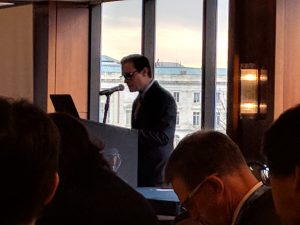
The theme of day was without a doubt the future of language education. Both keynote speakers, José Viana from the Office of English Language Acquisition with the Department of Education, and Fabrice Jaumont, author of The Bilingual Revolution, the Future of Education is in Two Languages, spoke about the increasing need for and access to dual language learning, beginning as early as possible. Mr. Viana spoke about the new necessity of bi- or even trilingual individuals, as the number of jobs requiring these skills has risen. He spoke on the government’s role in the increase of dual-language programs under the ESS (Every Student Succeeds) Act, the new preservation efforts of indigenous languages, and how current language legislation either kept or expanded programs, such as promotion of more immersion programs, the Seal of Biliteracy, and more.
Dr. Jaumont was looking at the future of language education by looking at the past and what has already been accomplished. Calling monolingualism “the illiteracy of the 21st century” and calling for an end to the perception of knowing a second language elitist or privileged, he went on to describe how it is possible through grassroots efforts to create bilingual programs, whether they be full immersion or just offering a second language. He called for more involvement with minority communities, using their language as an empowerment tool, in addition to benefiting directly from these programs, and stressed that bilingual education is only an opportunity to preserve heritage while also promoting English as a great equalizer. Although both men were speaking from different perspectives, the message was clear: we must not only promote but implement bilingual education for every student in every part of the country.
After a panel presentation on how bilingual education is already being implemented, both through private corporations and public education, sometimes from scratch, other times revitalizing what already exists, the educators, representing all 50 states, headed to Capitol Hill to talk to their congresspeople in both the Senate and the House.
The main talking points of the day were directed towards the maintenance of several education programs and the promotion of new ones. Advocacy for legislation was considered from all aspects of language learning, and took on many different aspects of upcoming legislation. Much of this advocacy was directed towards the FY18 budget, including maintenance of budget to programs that are in danger of being cut or eliminated, such as Part A of Title IV of the Every Student Succeeds Acts, which funds and promote education programs at all levels, including foreign language, and Title VI of the Higher Education Act, which funds study abroad programs including the Fulbright-Hays Act.
K-12 and higher education was not the only focus of the day. Maintenance of budget for the National Endowment for the Humanities, DARPA language technology, and the Defense Language Institute were also talking points for advocacy. While many of these programs were level with FY17 budget, with both pressing and looming importance of language learning in the intelligence community, the delegations were encouraged to promote expansion of budget and focus on projects that would increase language learning, citing language’s critical importance in defense and intelligence communities, which would also encourage several language learners who may not otherwise see the use of language in other fields.
Delegations were also promoting new programs being introduced in both the House and Senate, including the Seal of Biliteracy, a program that gives high school graduates language credentials in the second language of their choice, and the World Language Advancement and Readiness Act, a bipartisan bill that promotes K-12 education in languages with support from the Secretary of Defense and the Director of National Intelligence.
Without the JNCL’s support, it may have been difficult for language educators and specialists to come together and advocate for the profession in such a powerful way. Being able to meet with legislators to promote the profession through expert opinions and analysis is a rare opportunity, and doing it with legislators from all 50 states in one day is truly an amazing feat. The future of language learning is evolving every day, and Language Advocacy Day is helping promote a positive step towards that future.