
Jill Robbins, Ph.D., is the vice president of the National Museum of Language, as well as a language test developer at Second Language Testing, Inc. In this article, Dr. Robbins shares the fascinating story of a Ghanaian community that is helping its youngest members learn English by connecting them with their native language. The original article, as well as additional images and video, can be found on the Voice of America’s Learning English page.
Ghana’s official national language is English. But for most citizens English is also a second language.
Until recently, children in the country had to learn English as soon as they entered school. But, many had little contact with English, especially those in poor rural areas. As a result, many Ghanaian children never learned to read and write.
The National Literacy Acceleration Program (NALAP) was designed to help deal with this problem. The country-wide program opened in 2010. It teaches reading and writing in local languages during a two-year kindergarten program and during grades one through three. Then in grade four, children begin to study in English only.

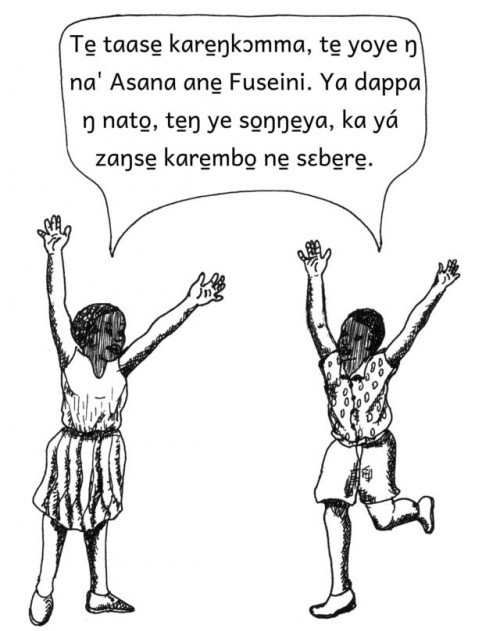
Student writing on the board in Safaliba – Illustration by Kotochi Mahama for Safaliba Literacy Texts
Safaliba is a rare language with about 7,000 speakers in several towns innorthern Ghana. It is mainly a spoken language. Among Safaliba speakers, the literacy rate in English is only eight percent.
Public school teachers in northern Ghana teach reading and writing in English and Gonja, one of the more common native languages in the area. The Ministry of Education provides the local schools with materials in those languages.
Safaliba had no common written form until 2003. A research team of Ghanaian and American educators is working to change that.
Writing an oral language
Paul Schaefer grew up in Ghana and works for the Christian based non-governmental organization GILLBT. That stands for Ghana Institute of Linguistics, Literacy, and Bible Translation. Beginning in 1998, he and his wife, Jennifer Schaefer, studied the Safaliba language. They worked together with Safaliba speakers to develop a way to write the language. They used this written language in adult literacy programs and published short books for the students to read.
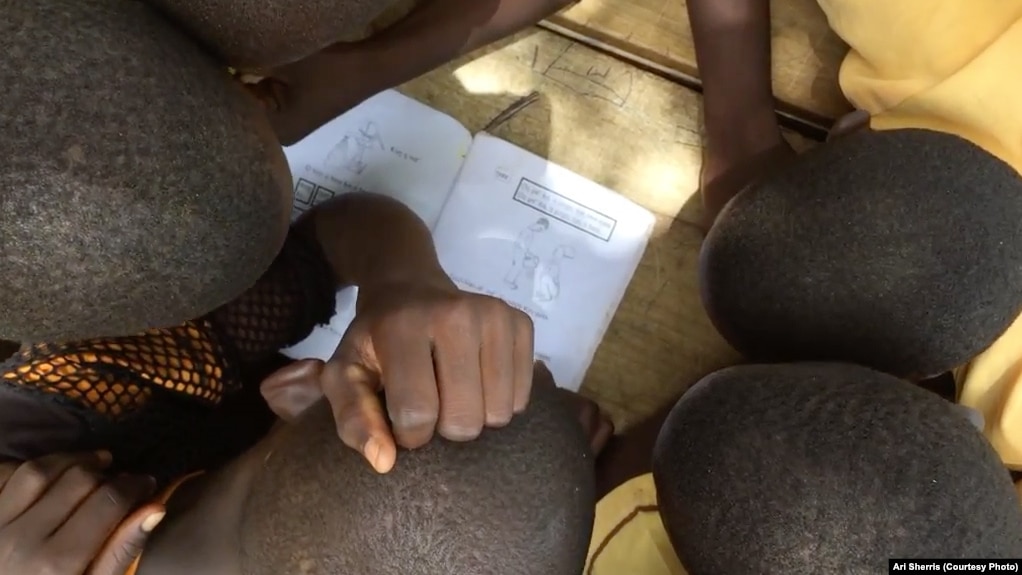
Children Reading in the Safaliba Language – Video by Ari Sherris
Iddi Bayaya is the main Safaliba literacy teacher. He is a farmer who had a few years of primary school education. Mr. Bayaya attended government-supported classes in Gonja and learned to be a literacy facilitator in that language.
Children want to learn, too
Soon children started coming to the adult classes. The young people learned the written language quickly. Paul Schaefer says the classes helped people learn the many ways written language could help them. He says they also learned that children who learn to read and write in their own language can use those skills in a second language and do better in school.
“So then they were basically saying that, well, we’ve seen that this does benefit the children in their formal education, why can‘t we have our language in the schools?”
Paul Schaefer says the idea came from the famous anthropologist Esther Goody.
“In her later years she was living here in Bole and doing research into education basically using local languages. She said, ‘you‘re doing adult education, but if you would focus on also getting the children educated, eventually there wouldn‘t be a need for adult education.’”
It was not long before the Safaliba community asked to enlarge the adult program to include children. Ari Sherris is a professor of bilingual education at Texas A&M University in Kingsville, Texas. He began working with the government literacy program in Ghana about ten years ago. Esther Goody introduced him to Paul Schaefer in 2012 and over the next two years they talked about ways to work together on the school project. In 2014, Mr. Sherris visited the Safaliba area twice and helped encourage the new movement to teach the Safaliba language in school. He plans to live with Safaliba speakers and help them create Safaliba–English bilingual books.
Meeting the need for teachers and materials
In January, the U.S. Department of State awarded Professor Sherris an education prize called a Fulbright. It will support him to come to Ghana for a year to help develop the bilingual program for school children in Safaliba and English.
Ari Sherris and Mr. Schaefer together visited a class in northern Ghana. They noticed that some children struggled with English while others did not. The educators learned that the more successful children attended the night classes with their parents.
“In teaching and observing in some of the classes, we realized that even at sixth grade, the majority were not able to read. But in the third grade, that we spent the most time in, we did some testing. Many of them did not know their letters. They did not know the sounds of the letters, which is not surprising, because the English alphabet is just extremely haphazard even if you know the language. We spent a few days teaching a few alphabet letters and linking them to key words in their local language. And just within a class period, you could see kids were grasping the whole point of an alphabet that hadn‘t ever before. You could see what could be done with it if it was done all the time. There is a sense of which, you don‘t want to claim too much, but there is another sense in which language is very powerful, and the language that you know is something that you can really build on.”
Since the Safaliba language has only recently been written, there are few materials for teachers and students to read.
“Well, one thing that’s absolutely critical is the issue of publishing materials. Even though we live in an era where a lot is done on the Internet, I don’t think it’s practical to have literacy without books. And so our biggest need is to be able to print more books.”
Paul Schaefer is happy that donors to the Safaliba project recently purchased a copy machine, called a duplicator. Having the duplicator in the Safaliba area makes it possible to do almost all the printing work locally. It will help the Safaliba community to print books in their own language. A Safaliba speaking artist, Kotochi Mahatma, will be creating illustrations for the books.
“This is not a photocopier but it is something that could make potentially thousands of copies. Our vision is that if we can turn it into something like a small local press, we’ll be able to meet their need for materials and possibly reach out to the other minority languages in the area.”
The new duplicator meant that GILLBT could publish a dictionary for beginning readers. The first bilingual dictionary of Safaliba and English was published in 2014. It has almost 1000 words. It will help both beginning readers of Safaliba and beginning learners of English. The dictionary also provides teachers with creative, fun, educational activities for young learners.
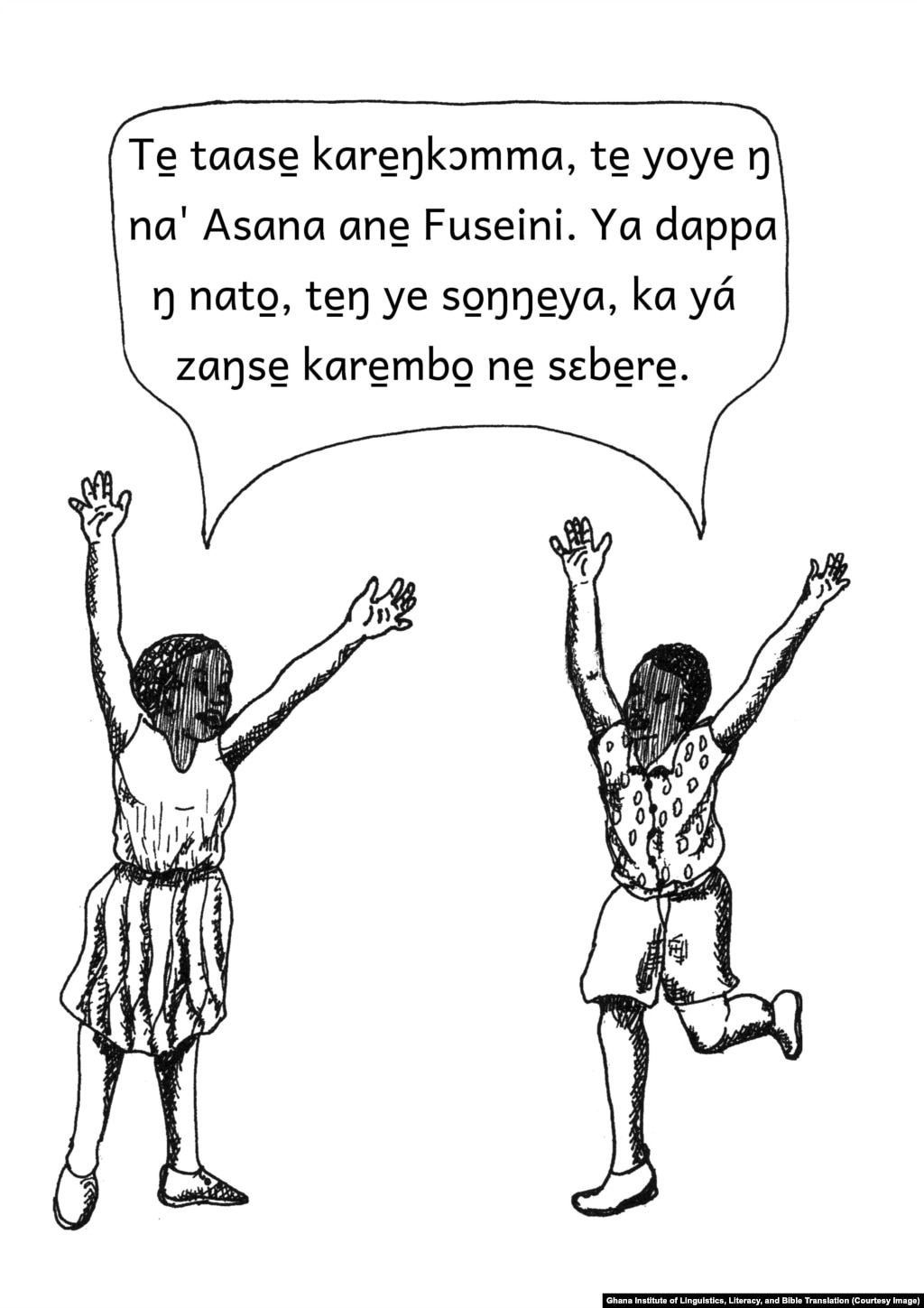
Local Languages and Literacy Programme Primer Illustration by Bondiyiri Mark
As their Chief hopes, young children in the Safaliba community can now learn to read and take pride in their language.
I’m Jill Robbins.
And I’m Jim Tedder.
Jill Robbins reported and wrote this story for Learning English. Caty Weaver was the editor.
______________________________________________________________
Words in This Story
kindergarten – n. a school or class for very young children
literacy – n. the ability to read and write
linguistics – n. the study of language and of the way languages work
translation – n. the act or process of translating something into a different language
primary – adj. relating to the education of young children
facilitate – v. to help (something) run more smoothly and effectively
practical – adj. likely to succeed and reasonable to do or use
illustration – n. a picture or drawing in a book or magazine
potentially– adv. possibly but not yet actually
press – n. a printing or publishing business