Why is There a Flag for Languages?

Gregory J. Nedved, an award-winning Defense Department historian and Museum trustee, writes this article on the value and meaning of flags.
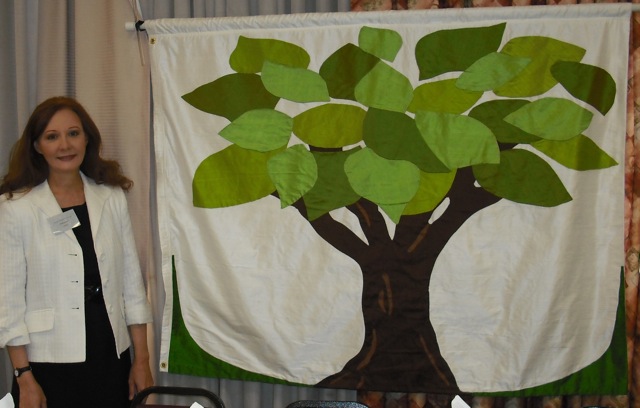
IFL_flag

Debra Kieft and the International Flag of Language, which she sewed, on display at the Annual Dinner of the National Museum of Language.

In 2008 the National Museum of Language (NML) held a contest to create the world’s only International Flag of Language (IFL), the end product of which is displayed at the Museum when it is not out on loan to other museums.  This is indeed a wonderful, eye-opening initiative but does it matter?  Why do you need a flag for languages?

Since languages have long existed without a flag to represent them, it is clear that you do not.

Indeed, an article a few years ago, “Flag as a Symbol of Language: Stupidity or Insult”, insisted that flags should not represent language.   Flags, the article maintains, represent countries and when people see the French tricolor they should think of France and not French.  A flag would only bring confusion.

This does not mean however that a language flag has no merit, serving no useful purpose.  A flag, since it is attention getting, is a good way to acknowledge a language, even bringing it legitimacy.  Said another way, if I was creating a language, I would create a flag to go along with it.  It is no accident that the Language Creation Society, an organization dedicated to the creation of constructed languages, has a flag.  Indeed, many constructed languages actually have them, Esperanto being the most celebrated example.  Since so many constructed languages have flags now, it seems as if a flag is almost becoming a requirement!  It is important to remember that these flags do NOT represent a country or region—they represent only the language per se.  There is no country of Esperanto for example. No country has anything to fear from these flags.

There is yet another way to look at this.  If you simply can’t get past the idea that flags must represent territory somehow (or even something concrete), then we will accommodate you by suggesting that language flags represent the whole world—universal territory per se.  Most (if not all) constructed languages are intended to be universal. The Esperanto flag represents a universal language.  Wasn’t in once supposed to be the language of the League of Nations?

Since the IFL represents all languages (past, present, future, natural and constructed), it is a universal flag by default.  It actually broadens the domain of a language flag since it is the only one so far that includes the non-constructed languages, i.e., English, German.  Furthermore, the IFL has now become the accepted symbol for languages in general, thereby legitimizing it (the flag has succeeded in legitimizing itself).   No such flag was known to exist prior to its creation.

No, languages do not need a flag but, as stated, there are undeniable advantages to them.  The IFL represents all languages.  We have flags for constructed languages now.  Could the non-constructed languages be next?   Yes, the age of the language flag is upon us.

Demo Title

Demo Description


My first Popup

This will close in 20 seconds

Fanni is Radnóti's wife
Located near the Tang capital city of Chang’an, site of the modern city of Xi’an in Shaanxi province, in central China.
Soldiers of that time commonly wore a white head cloth, similar to what is still worn by some peasants in China today.  The implication is that the conscripts were so young that they didn’t know how to wrap their head cloths, and needed help from elders.
Before China’s unification under the Qin dynasty in 221 B.C. there were several competing smaller kingdoms.  Han and Qin were two of these kingdoms. Han was located east of famous mountain passes that separated that area from the power base of the Qin dynasty, with its capital in Chang’an. The Qin dynasty itself only lasted about 15 years after unification due to its draconian rule, but soldiers under Qin rule retained a reputation as strong fighters.
The area of Guanxi, meaning “west of the passes”, refers to the area around the capital city of Chang’an.
This is an alternative name for a province in western China, now known as Qinghai, which literally means “blue sea”.  Kokonor Lake, located in Qinghai, is the largest saline lake in China.  
Before China’s unification under the Qin dynasty in 221 B.C. there were several competing smaller kingdoms.  Han and Qin were two of these kingdoms. Han was located east of famous mountain passes that separated that area from the power base of the Qin dynasty, with its capital in Chang’an. The Qin dynasty itself only lasted about 15 years after unification due to its draconian rule, but soldiers under Qin rule retained a reputation as strong fighters.
Oulart Hollow was the site of a famous victory of the Irish rebels over British troops, which took place on May 27, 1798. The rebels killed nearly all the British attackers in this battle. (Source: Maxwell, W. H. History of the Irish Rebellion in 1798. H. H. Bohn, London 1854, pp 92-93, at archive.org)
The phrase "United Men" is elaborated upon in the Notes section below.

Ghetto


An Italian word meaning “foundry.” It originally referred to a part of the city of Venice where the Jews of that city were forced to live; the area was called “the ghetto” because there was a foundry nearby. The term eventually came to refer to any part of a city in which a minority group is forced to live as a result of social, legal, or economic pressure. Because of the restrictions placed upon them, ghetto residents are often impoverished.

"You’re five nine, I am do-uble two"


A reference to the year 1959 and the year 2020.

"The Currency"


Meaning US dollars - this is drawing attention to the fact that Cuba is effectively dollarized.

"Sixty years with the dom-ino stuck"


This sentence is a reference to the Cold War notion that countries would turn Communist one after the other - like dominos. Cuba was the first domino, but it got stuck - no one else followed through into communism.

رحلنا


رحلنا, or "rahalna," means "we have left."

Habibi


Habibi means "my love."

Ra7eel


Ra7eel, or "raheel," means "departure."

3awda


3awda, or "awda," means "returning."

أهلاً


أهلاً, or "ahalan," means "welcome."

a5 ya baba


a5 ya baba, pronounced "akh ya baba," means "Oh my father."

golpe


Treece translates "golpe" as "beating", which is correct, however misses the secondary meaning of the word: "coup".

Carlos


The “Carlos” referred to in the poem is most likely Carlos Bolsonaro, a politician from Rio de Janeiro and the second son of Jair Bolsonaro, Brazil’s current president. His and his father’s involvement in Marielle’s murder has been questioned and investigated.