
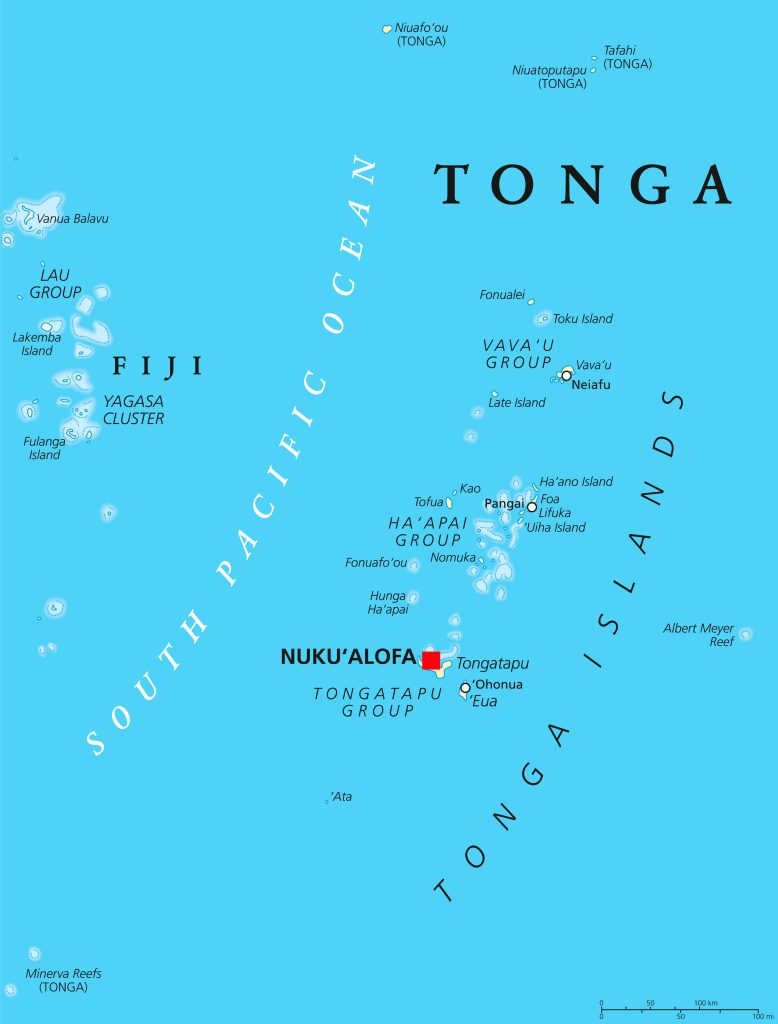
The Tongan language, or lea faka-Tonga, is an Austronesian language of the Polynesian branch spoken primarily in the Kingdom of Tonga, alongside its co-official language, English. It should not be confused with Tonga, a Bantu language spoken in parts of southern Africa. Instead, Tongan belongs to the great family of Pacific languages that includes Hawaiian, Māori, Samoan, Cook Islands Māori, and Tahitian. Within this larger Polynesian family, Tongan and Niuean form the smaller Tongic subgroup, reflecting a particularly close historical relationship between the languages.
Estimates of the number of speakers include over 100,000 speakers in Tonga in 2017, along with approximately 31,000 in New Zealand, 31,000 in the United States, and 17,000 in Australia, with additional speakers in places such as Fiji and American Samoa. The University of Hawaiʻi at Mānoa gives a broader estimate of approximately 126,000 native speakers across Tonga and its diaspora.
The survival and continued importance of Tongan is closely connected to the unusual political history of the islands. Tonga is the only surviving Indigenous monarchy in the Pacific and, unlike many neighboring Pacific societies, never completely lost its Indigenous system of governance. Tonga’s kings have ruled the islands in different forms for roughly a thousand years, while the modern monarchy developed during the nineteenth century. This political continuity helped create circumstances in which Tongan remained a language not simply of the home or village, but of national identity, government, religion, and public life.
This does not mean that Tongan escaped European influence. Europeans began attempting to record the language centuries ago. Dutch explorers Willem Schouten and Jacob Le Maire transcribed a small collection of Tongan words when they arrived in 1616, and Abel Tasman attempted to use collected Polynesian vocabulary when communicating with Tongans in 1643. More systematic writing developed with European missionaries in the nineteenth century, who experimented with different spelling systems. A grammar and dictionary associated with William Mariner was published in 1817, making it an important early written record of the language. Tonga’s modern orthography was eventually standardized through a decision of the Tongan Privy Council in 1943.
Today Tongan uses a Latin-based alphabet, but its writing preserves sounds that give the language its distinctive character. The alphabet includes the five vowels a, e, i, o, and u, as well as consonants including f, h, k, l, m, n, ng, p, s, t, and v. It also includes the fakauʻa, written ʻ, which represents a glottal stop and functions as a consonant rather than punctuation. The combination ng likewise represents a single consonant sound rather than a consonant cluster.
The language has a particularly regular rhythm. Every Tongan syllable contains a vowel, consonant clusters are not permitted, and syllables end in vowels. This means that every written vowel is meaningful to the pronunciation of a word. Vowel length is also important. A macron, known as a toloi, can be placed over a vowel—such as ā—to indicate that the vowel is long. Stress generally falls toward the end of a word, although vowel length and grammatical context can shift it. These characteristics help produce the open syllables and vowel-rich sound that Tongan shares with many of its Polynesian relatives.
Some of the most interesting features of Tongan become visible when it is compared with neighboring Polynesian languages. Words that appear different today can often be traced back to common ancestral forms. The Tongan word vaka, meaning canoe, for example, is related to Māori waka and Hawaiian waʻa. Likewise, Tongan tolu, meaning three, corresponds to Māori and Tahitian toru and Hawaiian ʻekolu. These similarities are not coincidences but evidence of the shared linguistic ancestry connecting Polynesian peoples across an enormous area of the Pacific Ocean.
The usual sentence structure is verb-subject-object and pronouns distinguish not only singular and plural but also a dual, used specifically when referring to two people. First-person pronouns further distinguish between inclusive forms, which include the person being spoken to, and exclusive forms, which do not. Perhaps even more revealing is the way social hierarchy is reflected in vocabulary. Tongan traditionally contains different registers of speech, including ordinary language, honorific vocabulary associated with chiefs, and regal vocabulary associated with the monarch. Additional distinctions can communicate politeness, formality, or humility.
Despite its relatively small number of speakers compared with global languages such as English, Spanish, or Mandarin, Tongan remains a living language with a strong national and cultural foundation. It appears in newspapers, books, the Christian Bible, education, conversation, and communities throughout the Tongan diaspora. It is also taught academically outside Tonga; the University of Hawaiʻi at Mānoa, for example, offers beginning and intermediate Tongan language courses.
Listen to the language here:
Learn more about Tongan here:
Sources
“ABOUT TONGA.” The Tongan Beach Resort, https://thetongan.com/about-tonga/. Accessed 22 Aug. 2026.
Tongan | University of Hawaiʻi at Mānoa. https://manoa.hawaii.edu/ipll/language-programs/tongan/index.php. Accessed 22 Aug. 2026.
Tongan Language, Alphabet and Pronunciation. https://www.omniglot.com/writing/tongan.htm. Accessed 22 Aug. 2026.
“Tongan Language.” Wikipedia, 14 June 2026. Wikipedia, https://en.wikipedia.org/w/index.php?title=Tongan_language&oldid=1359233094.